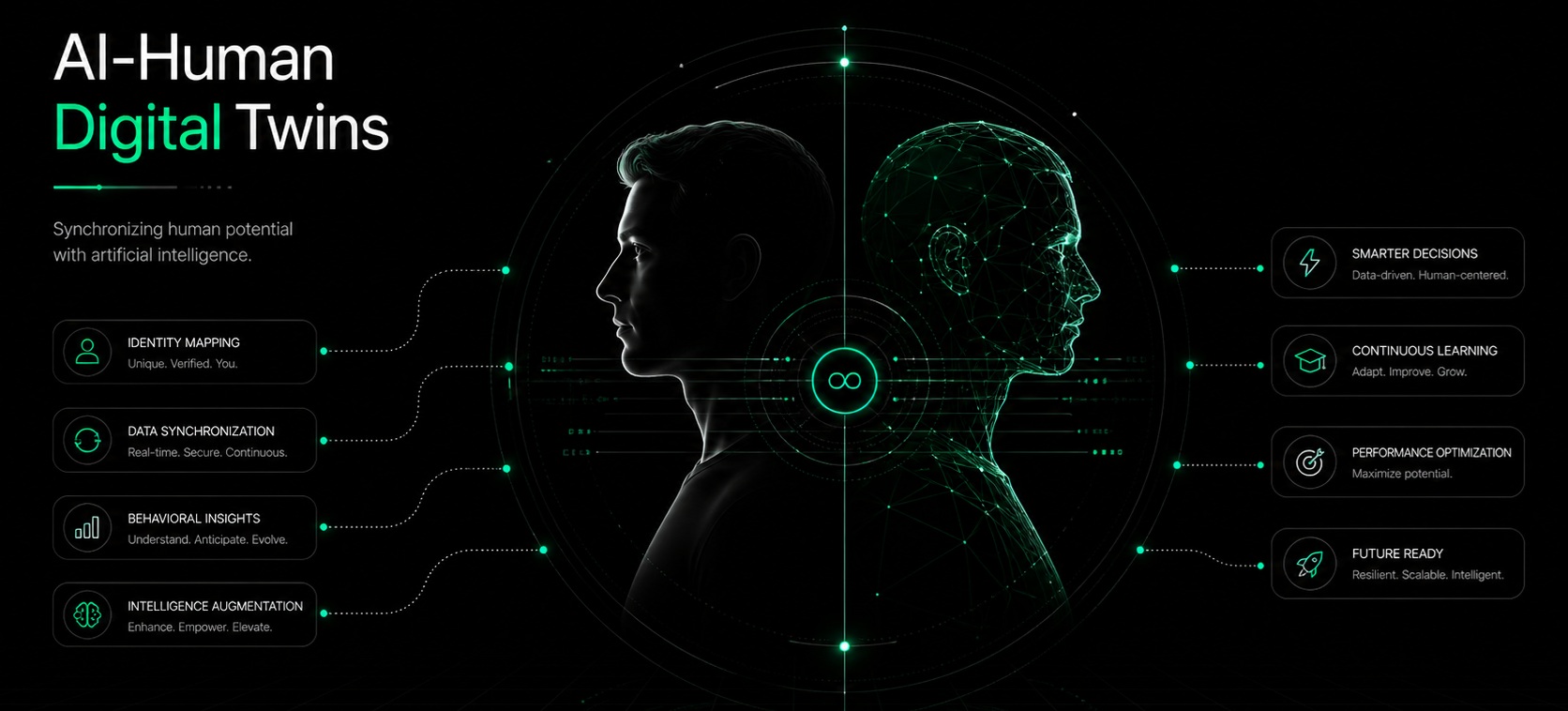
The Rise of the AI-Human
Digital Twin…
Artificial intelligence is moving from a tool we use to an infrastructure that increasingly acts around us. The next major step will not simply be better chatbots or more powerful assistants. It will be the rise of the human digital twin: a dynamic computational model of an individual, continuously updated by biological, behavioural, environmental, and social data. A human digital twin is not just a digital profile, medical record, or virtual avatar. It is a living model of a person’s state, context, risks, preferences, and possible futures.
Recent research describes human digital twins as an emerging field that combines sensing, modelling, artificial intelligence, and human-centred applications, while also noting that the field is still early and lacks mature universal frameworks. The realistic future is not that AI “becomes human.” It is that human life becomes surrounded by intelligent models of what we are, what we may become, and which actions might shift our trajectory.
2030
By 2030, the human digital twin is likely to appear first as a bounded personal agent. Its role will be practical rather than mystical. It will schedule meetings, screen messages, coordinate appointments, manage subscriptions, prepare documents, monitor routine health signals, and act across digital services with explicit permission.
This stage will be built on technologies that already exist in early form: multimodal AI, personal knowledge graphs, wearable sensors, smart-home systems, identity verification, and agentic software workflows. The twin will not need to be conscious or human-like. It will need to be context-aware, permissioned, interoperable, and auditable.
A useful 2030 twin may know that a person is sleep-deprived before recommending a financial decision. It may delay a non-urgent message when stress levels are high. It may book a doctor’s appointment after detecting a meaningful change in activity, heart-rate variability, or medication adherence. In professional life, it may prepare meeting summaries, detect overload, and negotiate calendar conflicts. In domestic life, it may coordinate energy use, grocery orders, transport, and reminders.
The main technical problem in 2030 will be delegation. If an AI acts on behalf of a person, what exactly is it authorised to do? Can it spend money? Cancel a meeting? Send a message? Share health data? Decline an invitation? The first serious failures may not be dramatic. They may involve ordinary but consequential mistakes: the wrong bill paid, the wrong appointment cancelled, the wrong tone used in a message, or the wrong risk inferred from incomplete data.
This is why the 2030 twin must be designed with clear permission layers, action logs, human approval thresholds, and revocation mechanisms. AI-enhanced digital twins are already being studied across multiple domains, with systematic reviews showing increasing integration between artificial intelligence and digital twin systems. The challenge is to bring that technical capacity into personal life without turning convenience into invisible control.
2040
By 2040, the digital twin may evolve from an agent that performs tasks into a system that simulates trajectories. The question will shift from “What should this person do next?” to “Which future state is this person moving toward?”
Healthcare will probably lead this transition. Digital twins are already being explored in health research as patient-specific models that could support diagnosis, treatment planning, and disease monitoring. A 2024 scoping review in npj Digital Medicine describes the rapid growth of digital twin applications in healthcare and identifies major opportunities as well as unresolved limitations.
By 2040, this logic may expand beyond medicine. A mature human digital twin could model health risk, cognitive load, emotional stress, financial vulnerability, learning patterns, social isolation, and environmental exposure. It would not predict the future with certainty. Instead, it would maintain a probability field of possible futures.
The individual is not a fixed object moving along one timeline. The individual becomes a shifting distribution of possible states. Each decision changes the distribution. Each new signal updates the model. Each intervention makes some futures more likely and others less likely. The twin may detect a rising probability of burnout weeks before the person consciously recognises it. It may see that sleep disruption, message tone, calendar density, and declining exercise are converging into a risk pattern. It may recommend reduced workload, earlier intervention, or social support.
The greatest risk in 2040 will be soft control. A digital twin may not command the user, but it may make some decisions appear irrational, unsafe, or statistically inferior. When a machine can model consequences better than the individual, recommendation becomes a form of power. The user may remain technically free while becoming psychologically dependent on the model’s forecasts.
2050
By 2050, the most advanced human digital twins may become persistent computational extensions of identity. They may interact not only with apps, but with institutions: hospitals, banks, insurers, employers, universities, courts, vehicles, homes, robots, and city infrastructure.
At this point, the twin becomes less like software and more like an exo-self: a computational layer that represents the person’s interests, memory, permissions, constraints, and goals across society. It may negotiate with other systems, defend against manipulation, monitor long-term wellbeing, and help preserve continuity through ageing, illness, relocation, or cognitive decline.
The roots of this idea are already visible in Industry 5.0 research, where the human digital twin is framed as part of a human-centred approach to smart systems. Wang and colleagues describe human digital twins as important for human-centric manufacturing, where safety, wellbeing, personalisation, and human-machine collaboration become central design goals. By 2050, similar principles may extend from industry into everyday life.erely about the person.
A 2050 twin could warn that a contract conflicts with a person’s long-term risk tolerance. It could detect that a work pattern resembles a previous burnout cycle. It could advise that a medical option is inconsistent with treatment history. It could recognise that a financial decision improves short-term convenience but damages long-term resilience. It could also preserve personal values in environments where institutions are optimised for efficiency rather than human flourishing.
But the central issue in 2050 will be ownership. Who owns the human digital twin: the individual, the platform, the employer, the insurer, the state, or the healthcare provider? If the twin becomes a meaningful extension of the person, ownership becomes more than a commercial issue. It becomes a rights issue.
A credible future requires governance by design. The twin must be private, portable, revocable, auditable, and accountable. It must support machine-readable consent, clear authority boundaries, independent review, data minimisation, and legally enforceable shutdown. Most importantly, it must act for the person, not merely about the person.
realism
The most powerful future is not mind uploading. It is not a perfect digital copy. It is not a synthetic soul.
The realistic “wow” is that each person may live beside a constantly updating model of their possible futures.
This model will not know everything. It will be incomplete, uncertain, and sometimes wrong. But if built well, it may help people detect risk earlier, make better decisions, preserve autonomy, and navigate systems too complex for unaided cognition.
By 2030, AI may act for us.
By 2040, AI may model us.
By 2050, AI may become a recognised extension of us.
The defining question is not whether this can be built. The early foundations are already visible in digital twin research, healthcare modelling, and AI-integrated systems. The defining question is whether it can be built without reducing the person to a data object.
The human digital twin should not become a behavioural control system. It should become a cognitive prosthetic for agency.
The future of AI-integrated life is not that machines become human. It is that human beings become surrounded by computational mirrors of what they could become. The ethical task is to ensure those mirrors do not trap us inside predicted futures, but help us choose better ones
Further Reading
Digital twins for health: A scoping review
Journal: npj Digital Medicine
https://www.nature.com/articles/s41746-024-01073-0
This review examines how digital twins are being applied in healthcare, including disease modelling, patient-specific prediction, and treatment planning. It is useful for grounding the article’s argument that healthcare is likely to be one of the first serious domains for human digital twin development.
–
Artificial intelligence in digital twins
Journal: Data & Knowledge Engineering
https://www.sciencedirect.com/science/article/pii/S0169023X24000284
This paper reviews how AI is being integrated into digital twin systems across multiple domains. It supports the article’s claim that future digital twins will rely on AI for prediction, simulation, optimisation, and decision support.
Human digital twin: A survey
Journal: Journal of Cloud Computing: Advances, Systems and Applications
https://link.springer.com/article/10.1186/s13677-024-00691-z
This survey provides a broad overview of human digital twin research, including definitions, technologies, applications, and challenges. It is one of the most directly relevant sources for explaining what a human digital twin is and why the field is still emerging.
–
Human Digital Twin in the context of Industry 5.0
Journal: Robotics and Computer-Integrated Manufacturing
https://www.sciencedirect.com/science/article/abs/pii/S0736584523001011
This article connects human digital twins with Industry 5.0, where human-centred design, safety, wellbeing, and human-machine collaboration are central. It is useful for positioning the digital twin as more than automation: a system designed around human agency and interaction.
